

After SEO Comes GEO:Most E-Commerce Sellers Haven't Started
- ZQdropshipping
- 12 hours ago
- 14 min read


Summary
Adobe data confirms AI shoppers convert 42% better than human traffic and spend 48% longer on site. Amazon has blocked OpenAI's crawlers from its entire product catalog. A discipline called Generative Engine Optimization is rewriting how products get found, and the rules are completely different depending on where you sell
Two April 2026 datasets tell the same story from opposite ends of the transaction. Adobe Analytics, drawing on over one trillion U.S. retail site visits, found that AI-referred shoppers now convert 42% better than non-AI traffic, spend 48% longer on site, and show 12% higher engagement rates. A separate EcomFuel survey of 300 store owners found 72% have adopted AI, primarily for writing product copy. The gap between those two numbers reflects a structural shift most sellers are only partially responding to. That shift has a name: Generative Engine Optimization, or GEO. It operates on entirely different logic depending on which platform a seller uses, and the rules are not interchangeable.
The Numbers That Define the Moment
In March 2025, Adobe Analytics showed AI-referred visitors converting 38% worse than standard traffic from paid search and email. Most retailers deprioritized the channel. The buyers arriving from AI sources were less likely to purchase, less engaged, and not worth optimizing for.
Twelve months later, that calculation has reversed completely.
Adobe's April 2026 report, based on analysis of over one trillion visits to U.S. retail websites, documented a new record in March 2026: AI traffic converting 42% better than non-AI sources. The same dataset showed AI visitors spending 48% longer on site and displaying engagement rates 12% higher than visitors from every other channel. Adobe's own survey of more than 5,000 U.S. consumers found that 39% now use AI for online shopping, and 66% believe AI tools provide accurate results, a trust level that has driven the conversion reversal. The volume behind these numbers is equally striking. AI-driven traffic to U.S. retailers grew 393% year-over-year in Q1 2026. During the 2025 holiday season, that figure reached 693%.

On the seller side, EcomFuel's April 2026 report surveyed 300 store owners, the majority running businesses between $1 million and $100 million in annual revenue. Seventy-two percent said they had meaningfully incorporated AI into their operations. Top uses: copywriting, image generation, data analytics, coding. Andrew Youderian, EcomFuel's founder, told Practical Ecommerce that most operators remain in what he called the "investment stage," with clear ROI still elusive for the majority.
The contrast is the central problem. Consumers using AI to shop are generating the highest-quality traffic any digital channel has ever produced. Sellers using AI are mostly generating faster content. These are two different applications of the same technology, and only one of them is producing measurable commercial results.
Where the Purchase Journey Now Begins
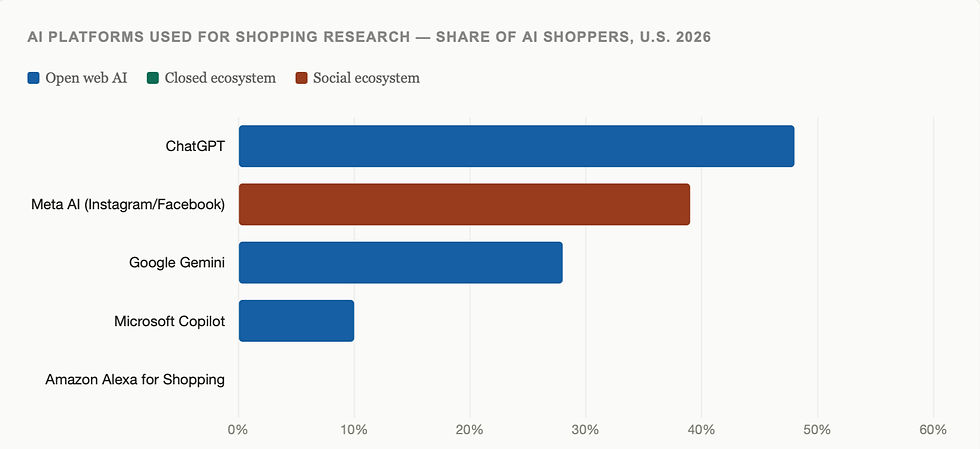
Understanding the gap requires looking at where consumers actually go when they use AI to shop. Smarty Marketing's survey of 1,295 U.S. consumers, published May 12, 2026, provides the clearest current picture. Among the 60% of respondents who have used AI for shopping research, ChatGPT is the most-used platform at 48%, followed by Google Gemini at 28%, Microsoft Copilot at 10%, Claude at 7%, and Perplexity at 4%. A separate SEMrush study of 1,030 U.S. shoppers found Meta AI (accessed through Instagram, Facebook, and WhatsApp) reaches 39% monthly usage among AI shoppers, making it the second-largest AI shopping surface when measured across Meta's family of apps.
What matters for sellers is understanding what each of these platforms actually does when a consumer asks a product question. None of them, with one partial exception, can access live pricing or inventory from external retailers. They are not checking whether a product is in stock or what it costs today. They are making a judgment about which products are worth recommending based on the signals available to them. Those signals vary dramatically by platform, and that variation is the foundation of GEO.
What Amazon Did, Why It Did It, and What It Changed
To understand GEO, you need to understand the most consequential single action any platform has taken in AI commerce so far: Amazon's decision to block OpenAI's crawlers from its product catalog.
In September 2025, OpenAI launched Shopping Research, a feature that allowed ChatGPT users to ask product questions and receive specific recommendations with purchase links. To build those recommendations, ChatGPT's crawler (ChatGPT-User) would access retailer websites in real time, reading product pages, prices, availability, and reviews. For Amazon, this created an immediate commercial problem. ChatGPT could access Amazon's product data, use it to make recommendations, and then route the buyer to whatever purchase destination it found most credible. That destination was not always Amazon.
Amazon's response was straightforward. It updated its robots.txt file to explicitly block ChatGPT-User and OAI-SearchBot from crawling its website. The move was first identified by ecommerce analyst Juozas Kaziukėnas and confirmed by eMarketer and TechRadar. Testing by TechRadar and Modern Retail verified the practical effect: ChatGPT can no longer read Amazon's product pages, prices, specifications, or reviews in real time.

ChatGPT can still recommend a brand that sells primarily on Amazon, because that brand's reputation exists in third-party content ChatGPT can still reach. But the purchase link it provides points to that brand's own website, a Google Shopping result, or a review site. Not to amazon.com. Amazon's data was used to build ChatGPT's knowledge of the category. The transaction is no longer routed through Amazon.
Amazon also updated its legal terms to restrict AI agent purchasing behavior and filed litigation against Perplexity for unauthorized purchases made through its Comet browser agent. These are not isolated legal actions. They are the perimeter of a deliberate strategic position: Amazon intends to keep the discovery-to-purchase journey inside its own ecosystem, where it controls the search results, the sponsored placements, and the checkout.
The consequence for the broader market is a structural gap. ChatGPT's shopping recommendations now need to route buyers somewhere other than Amazon for the product categories where Amazon was the natural destination. That gap is being filled by independent stores, brand websites, and third-party retailers. The ones capturing that traffic are the ones that have built the signals ChatGPT uses to make recommendations and the destinations ChatGPT can send buyers to. This is what GEO is.
Generative Engine Optimization is the practice of building the signals that cause AI systems to recommend your product when a buyer asks a relevant question. SEO determined where a page ranked in a list of links. GEO determines whether an AI mentions your product by name when a buyer describes what they need. The underlying logic of each platform is different, and so is the optimization work required.
How Each AI Platform Actually Makes Recommendations
The most common and costly GEO mistake is treating all AI platforms as equivalent. Each platform draws from different data sources and weighs different signals. Optimization work that improves visibility on one platform may have no effect on another.
PLATFORM | DATA SOURCE | REAL-TIME PRICING/INVENTORY | PRIMARY RECOMMENDATION SIGNAL |
ChatGPT | Open web crawl. Amazon catalog blocked since late 2025. Heavy reliance on Google Shopping data as fallback, with 75% overlap with Google Shopping top results. | No. Recommendations based on indexed content, not live retailer data. | Third-party editorial coverage, review site presence, Reddit discussion, brand website content quality. |
Google Gemini | Google Shopping Graph, a database of products submitted by merchants via Google Merchant Center. Also crawls open web. | Partial. Real-time pricing and inventory only for merchants with active Merchant Center feeds. Sites without a feed are absent from Gemini's shopping layer. | Merchant Center feed completeness, Product Schema structured data, organic search authority. |
Microsoft Copilot | Bing index and Bing Shopping. Built on the same underlying models as ChatGPT but distributed primarily through Windows, Edge, and Microsoft 365. | No. Recommendations based on Bing's indexed product data, which updates on a crawl cycle. | Bing product catalog feed quality, pricing competitiveness signals, value-oriented content. Electronics and home goods dominate 45% of Bing shopping searches. |
Meta AI | Meta Shops catalog data (primary). Bing-powered web search layer (secondary). Behavioral and social graph data from 3 billion daily active users across Facebook, Instagram, WhatsApp. | No for general web queries. Partial for merchants with active Meta Shops catalogs integrated into the platform. | Meta Shops catalog quality and completeness, ad engagement history, social graph interest signals, Bing-indexed web presence. |
Amazon Alexa for Shopping | Amazon's internal catalog only. Does not crawl the open web. Has complete real-time access to Amazon pricing, inventory, and purchase history. | Yes, but only within Amazon's ecosystem. No visibility into external retailer data. | Listing attribute field completeness, Q&A depth, review volume and sentiment, purchase history signals. |
McKinsey's research, published on its official website in January 2026, projects that AI agents could mediate between $3 trillion and $5 trillion of global consumer commerce by 2030 under moderate adoption scenarios. The brands capturing that volume will not be the ones with the largest ad budgets. They will be the ones whose products are structured, cited, and machine-readable across the platforms where buyers are already searching.
Amazon Sellers: Optimizing Inside the Wall and Building Outside It
Amazon sellers face a split that did not exist two years ago. Inside Amazon's ecosystem, Alexa for Shopping (which replaced Rufus in May 2026) has fundamentally changed what good listing optimization looks like. Outside Amazon's ecosystem, the crawler block has created both a problem and an opportunity that most sellers have not yet acted on.
Inside the ecosystem first. Amazon's Q3 2025 earnings call, where CEO Andy Jassy disclosed Rufus performance data, established the commercial scale of AI-assisted shopping on the platform. Sensor Tower's analysis of over 100,000 real Amazon shopping sessions during the 2025 holiday season provided independent verification.

The implication for listing strategy is direct. Alexa for Shopping does not rank products the way A9 ranked them. A9 rewarded keyword density and match frequency. Alexa for Shopping is built around semantic intent: it parses what the buyer actually needs and tries to match it to a product that can demonstrably fulfill that need. A listing stuffed with search terms but lacking precise attribute data (materials, dimensions, compatibility, use-case specifications) may maintain its organic rank while being bypassed entirely by Alexa's recommendation layer. Filling attribute fields completely, building Q&A sections that answer real buyer questions, and writing copy in natural language that describes the product's actual use case are now distinct optimization tasks from traditional SEO, and they require deliberate attention.
Outside the ecosystem is where the more urgent gap exists. Because ChatGPT can no longer route buyers to Amazon listings, sellers whose brand exists only inside Amazon's catalog are invisible to the largest open-web AI discovery platform. A buyer asking ChatGPT for the best product in a category may receive a recommendation that names a brand sold primarily on Amazon, because third-party reviews and community discussions have established that brand's credibility in ChatGPT's data layer. But the link ChatGPT provides will point to that brand's own website or a comparison site. Not to Amazon.
The minimum viable external presence for an Amazon seller is not a full direct-to-consumer operation. It is a brand website with Product Schema markup on product pages, a Google Merchant Center product feed, and enough third-party editorial presence (a review article, a forum discussion, an editorial mention) for ChatGPT to have a source to cite and a destination to send buyers. Sellers who have built this are capturing AI-referred traffic that their Amazon-only competitors are not seeing at all.
Independent Store Sellers: The Structural Advantage, and Its Conditions
Independent store sellers have a structural GEO advantage that Amazon sellers lack: their product pages are crawlable by every major open-web AI system. ChatGPT can index them. Gemini can surface them through the Shopping Graph. Copilot can find them through Bing. Amazon's decision to block OpenAI's crawlers from its own catalog did not block independent stores. The gap Amazon created in ChatGPT's product recommendation coverage is actively being filled by open-web sellers. But crawlable does not mean recommended, and the conditions for being recommended are specific.
Adobe's April 2026 data on AI readability makes the gap between crawlable and recommendable concrete. Across U.S. retail websites, product detail pages score an average of 66% on Adobe's AI Content Visibility Checker, meaning roughly a third of product page content is invisible to AI systems. The best-performing retailers score 82.5%. The worst score 54.2%.

A product page that scores 66% on AI readability is not half-visible. It is potentially absent from AI recommendations entirely for the queries where the unreadable third of content would have been the deciding signal. If a product's specifications, materials, or compatibility data sit inside images, JavaScript-rendered elements, or formats that AI crawlers cannot parse, those details do not exist in the AI's understanding of the product.
Product Schema structured data is the technical foundation that addresses this. It is the code embedded in a product page that tells AI crawlers exactly what a product is: its name, category, price, availability, rating, and specifications, in a standardized machine-readable format. It is also the prerequisite for appearing in Google Gemini's shopping recommendations, since Gemini draws its product data from Google's Shopping Graph, which is built from Merchant Center feeds, not web crawls.
An independent store with strong organic search rankings but no Merchant Center feed is absent from Gemini's shopping layer regardless of how well it ranks in text search. These are separate systems. A page that ranks on Google Search does not automatically populate the product data Gemini uses for shopping recommendations. Submitting a complete and accurate Merchant Center feed, with real-time pricing that matches the live site, is the action that puts a store's products into the data layer Gemini actually reads.
For ChatGPT and Perplexity, the critical signals are off-site. ChatGPT's product recommendations show 75% overlap with Google Shopping top results, but the purchase routing it provides depends on whether the brand has credible third-party coverage: editorial reviews, comparison guides, community discussion in the sources ChatGPT trusts. Perplexity, which in February 2026 announced it was abandoning advertising revenue in favor of subscriptions and commerce, surfaces recommendations based entirely on what its real-time web crawl finds in trusted sources: Reddit, expert blogs, and independent publications. A platform that earns nothing from ad placement has no financial incentive to surface paid results over organic ones. What Perplexity surfaces is what credible sources say about a product. That community and editorial signal cannot be purchased. It has to be earned.
Social Commerce Sellers: Three Logics, One Ecosystem
Social commerce sellers operate across platforms that use AI in three distinct ways, and conflating them produces the wrong optimization priorities. TikTok Shop, Instagram Shopping, Facebook Shops, and the Meta AI shopping assistant do not all work the same way. Understanding the difference determines where a seller's optimization effort actually has leverage.
The content algorithm layer: TikTok, Instagram Reels, Facebook Reels
Across TikTok, Instagram, and Facebook, the primary discovery mechanism for commerce is the short-video algorithm, and its logic has no direct equivalent in the GEO framework built around structured data and product feeds. These algorithms do not recommend products based on catalog data. They recommend content based on performance signals: video completion rate, comment volume and sentiment, share behavior, and save rate. A product surfaces because a video about it performed well, not because the product's listing attributes are complete or its specifications are machine-readable.
This means the GEO playbook built around Product Schema, Merchant Center feeds, and structured data is largely irrelevant for the content algorithm layer. The optimization surface is the video itself: its hook, format, pacing, and the authenticity of the engagement it generates. This holds equally across TikTok, Instagram Reels, and Facebook Reels, all three of which now use completion rate as their primary distribution signal and surface 50% or more of feed content from accounts users do not follow.
The practical implication for sellers: optimizing product data for AI readability will not move content algorithm rankings. What moves rankings is content that holds attention and generates genuine engagement. These are separate disciplines, and most sellers who are strong on one are not systematically investing in the other.
The Meta AI shopping assistant: a different logic entirely
In March 2026, Meta announced at the Shoptalk conference that it was deploying a new AI shopping assistant across Instagram and Facebook. The feature activates when a user clicks on an ad or visits a merchant's page within the app: an AI pop-up surfaces product review summaries, brand information, complementary recommendations, and a one-tap checkout button powered by Stripe and PayPal.
This is a fundamentally different system from the content algorithm. Meta AI's shopping recommendations draw from two sources. The primary source is Meta Shops catalog data, which is the structured product information that sellers submit directly to Facebook and Instagram Shopping. The secondary source is a Bing-powered web search layer that pulls from a seller's website and broader web presence. The behavioral and social graph data Meta holds on over three billion daily active users provides the personalization layer: which users see which recommendations is shaped by their interest signals, engagement history, and social connections.
For sellers, the optimization requirements for Meta AI shopping are meaningfully different from TikTok's content algorithm. Meta Shops catalog quality (accurate product titles, descriptions, pricing, and inventory) determines whether a product can be surfaced in Meta AI's recommendations at all. The website's technical foundation and content quality affect how well the Bing search layer can represent the brand. And the ad creative and engagement history on the platform influence which users the Meta AI surfaces recommendations to. A seller optimized for Instagram's content algorithm but with a poorly maintained Meta Shops catalog will be invisible to Meta AI's shopping assistant even as their Reels perform well.
The cross-platform signal loop
The third dynamic social commerce sellers need to understand operates across platforms rather than within any single one. When a video on TikTok, Instagram, or Facebook generates significant engagement, it produces a secondary wave of content that feeds directly into open-web AI systems: Reddit threads asking whether the product works, YouTube reviews from creators who saw the trend, editorial mentions in newsletters and product blogs. Perplexity indexes these in real time. ChatGPT's data layer incorporates them over time.
Adobe's May 2025 consumer survey found that 47% of Gen Z discovered new brands through ChatGPT this year. Many of those brands first entered Gen Z's awareness through social video. The path from social discovery to AI recommendation runs through the community discussions and editorial coverage that high-performing content generates, not through any direct technical integration between social platforms and AI search systems.
TikTok Shop listings, Instagram Shopping product tags, and Facebook Shop catalogs are not crawlable by ChatGPT, Gemini, or Perplexity in the way that independent store product pages are. A seller whose inventory exists only inside these social commerce catalogs has no product data layer that external AI systems can read. The cross-platform signal loop, where social content generates community discussion that AI search systems then surface, is the primary path to open-web AI discoverability for social commerce sellers. It is slower and less controllable than structured data optimization, but for sellers who build it deliberately, it compounds in a way that paid discovery cannot replicate.
The Window That Remains Open
Adobe's 693% holiday season figure and the 393% Q1 figure describe a channel growing at a pace no previous digital commerce channel matched at a comparable stage of adoption. The conversion quality is already higher than paid search or email. The infrastructure for AI-mediated commerce is live and expanding: Amazon's Alexa for Shopping, Google's Universal Commerce Protocol, OpenAI's Agentic Commerce Protocol, and Meta's AI shopping assistant.
What has not scaled yet is the seller side. EcomFuel's data makes this concrete: 72% of independent store owners have adopted AI, but into copywriting and content generation. GEO is not a content production tool. Building Product Schema on every product page, submitting and maintaining a Merchant Center feed, earning third-party editorial coverage, maintaining a clean Meta Shops catalog, establishing community presence in the sources Perplexity trusts: none of these are content tasks. They are infrastructure tasks. And infrastructure compounds over time in a way that content production does not.
McKinsey's $3 trillion to $5 trillion projection for 2030 is a scenario, not a guarantee. But the directional signal it describes is already visible in Adobe's Q1 2026 data: AI-referred buyers are converting at 42% better rates than human traffic, and that gap set a new record in March 2026. The sellers who are building GEO infrastructure now, before the channel becomes crowded enough that everyone has noticed it is worth building, are compounding an advantage that will be structurally difficult for later entrants to close.
The channel is not at mainstream scale yet. That is the window.
Sources
Adobe Analytics — "AI Traffic Grows but Retail Sites Lag in AI Search Visibility" — Vivek Pandya, Director, Adobe Digital Insights — April 16, 2026
EcomFuel / Practical Ecommerce — "EcomFuel Founder on 2026 Industry Trends" — Eric Bandholz — April 10, 2026
Smarty Marketing — 2026 AI Consumer Shopping Survey, 1,295 U.S. respondents — May 12, 2026
SEMrush — AI Tools and the Modern Buyer Journey, 1,030 U.S. shoppers — via ALM Corp — March 2026
Meta — Shoptalk 2026 AI Shopping Announcement — March 25, 2026
Athos Commerce — "One Product Feed Won't Win Five AI Shopping Engines" — Mark Batson — April 10, 2026
McKinsey & Company — "Agentic Commerce: How AI Shopping Agents Can Change Retail" — January 28, 2026
Sensor Tower — Amazon Holiday Shopping Session Analysis, 100,000+ sessions — via The Drum — January 2026
Amazon — Q3 2025 Earnings Call, CEO Andy Jassy on Rufus performance — November 2025
eMarketer — "Amazon Moves to Shut Out ChatGPT Bots as Agentic Shopping Pressure Rises" — 2025
TechRadar — "Amazon Blocks ChatGPT's New Shopping Agent" — 2025
Adobe — 47% of Gen Z Found a New Brand Through ChatGPT This Year — May 2025 Consumer Survey, 800 U.S. respondents


Comments